Services / Basement Floor Epoxy
Basement Floor Epoxy
Moisture-tested, properly primed, and built to stay bonded. No peeling.
Basements are tricky. Moisture migrates through concrete slabs, which is why most DIY epoxy jobs peel within a year. We test for moisture before we quote, use the right primer for your slab condition, and apply systems rated for below-grade installs. The floor lasts. No peeling.
How we do it.
Below-grade concrete is the hardest surface to coat correctly. Water vapor migrates up through the slab year-round, and if the coating system doesn't account for that vapor pressure, it will delaminate — sometimes in months, sometimes in weeks. We've pulled up plenty of DIY and budget installs that couldn't handle it.
Every basement quote starts with a moisture test. We use a calcium chloride test or relative humidity probe to measure vapor transmission through your specific slab. If the reading is acceptable, we proceed with a standard primer. If it's elevated, we use a moisture-mitigating epoxy primer that chemically bonds to the slab even in the presence of moisture.
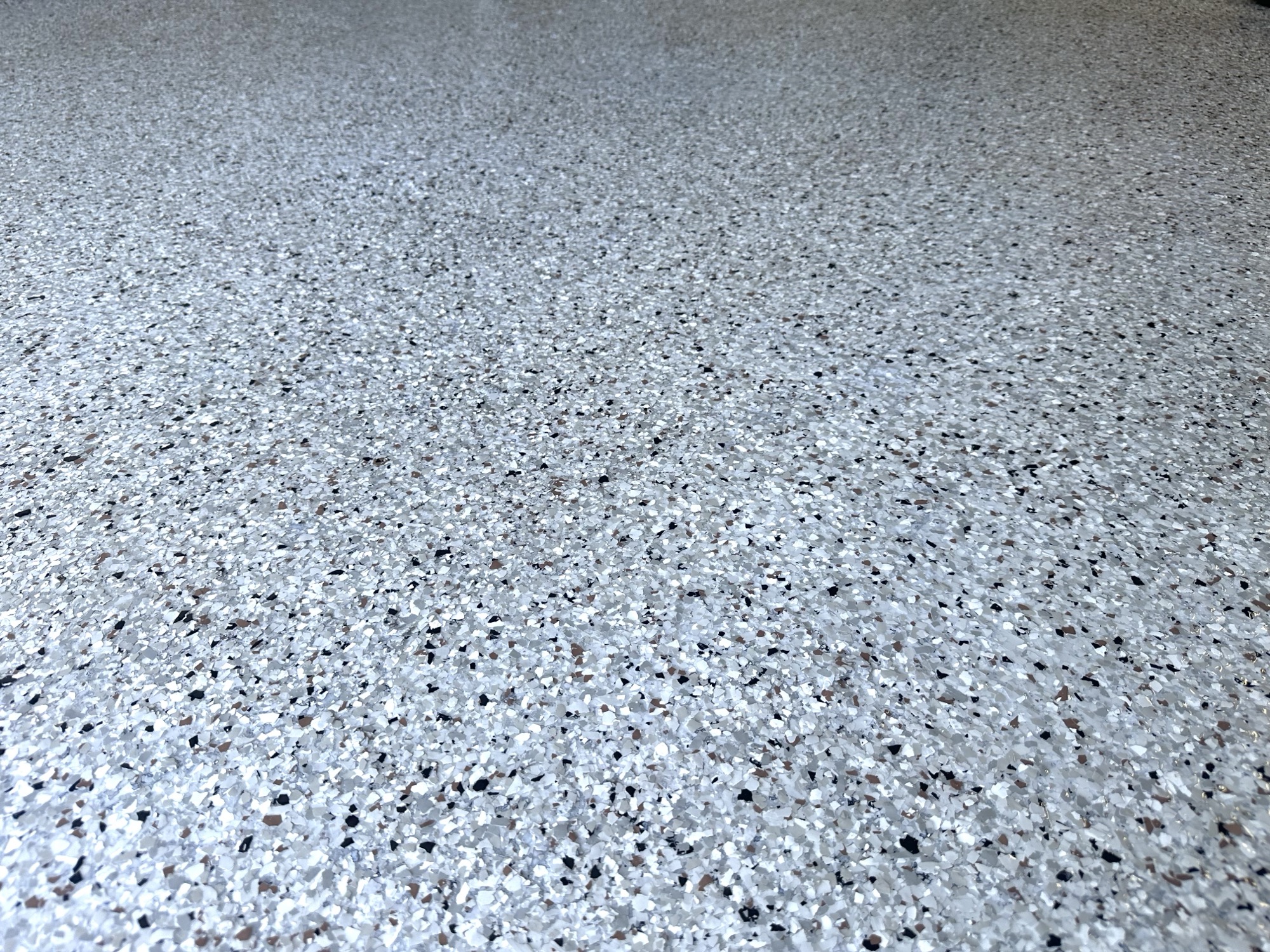
For finished basements, metallic epoxy is a popular upgrade — the self-leveling pigment creates depth and movement in the floor that looks intentional rather than industrial. For utility spaces, a standard flake system is usually the right call: durable, easy to clean, hides imperfections well.
What's included
Fair questions.
Straight answers.
Anything we didn't cover, call us. You'll get a person, not a phone tree.
It depends on the severity. We test before we quote. Mild to moderate moisture vapor is manageable with the right primer. Actively hydrostatic slabs — where water seeps in after rain — need waterproofing work before any coating can be applied.
The floor will be foot-traffic ready the next morning. We recommend keeping furniture off for 48 hours and avoiding heavy loads for 72 hours, after which the coating is at full strength.
Two reasons: they skip moisture testing, and they use water-based epoxy that can't handle vapor pressure. Professional-grade solvent-based and 100% solid epoxy systems are not available at hardware stores.
Minor cracks can be filled with epoxy crack filler as part of the surface prep. Significant structural movement cracks should be evaluated by a foundation specialist first — coating won't fix a structural issue.